Acreages and rural development, southern and central Alberta
Private sewage (PSTS) soil and site evaluation
On an acreage or rural parcel with no municipal sewer, the soil is the last treatment step. A private sewage soil and site evaluation reads that ground the way the designer and the safety codes officer need it read: what the soil is, how much effluent it will accept, and how much clean earth sits above the nearest restricting layer. Every report is logged, analysed, and sealed by a Professional Engineer registered with APEGA.
Logged and sealed by Andrew Richardson, P.Eng.
What this is
The work, and what it answers
A private sewage soil and site evaluation is the subsurface investigation that decides whether a piece of ground can safely treat and disperse household wastewater, and which kind of system it will carry. On acreages and rural parcels with no municipal sewer, every home depends on a Private Sewage Treatment System (PSTS), and the native soil is the final polishing and dispersal stage. Get the soil wrong and the system fails early, backs up, or contaminates a well; get it right and it runs quietly for decades.
The evaluation answers three linked questions. What is the soil, described by texture and structure? How much effluent will it accept per day, its loading rate? And how much clean, unsaturated soil sits between the bottom of the dispersal area and the nearest restricting condition, meaning the seasonal-high water table, bedrock, or an impermeable or otherwise restrictive layer? Those three answers set the size, the type, and the depth of everything the designer builds.
In Alberta this work is governed by the Alberta Private Sewage Systems Standard of Practice 2021, published by the Safety Codes Council. It is followed directly: the ground is described by the Canadian System of Soil Classification, and the design basis comes from the soil itself rather than from a shortcut. Andrground Engineering serves southern and central Alberta, and every evaluation issued is logged, analysed, and sealed by Andrew Richardson, P.Eng., registered with APEGA.
Method
What the evaluation is, and when you need one
A private sewage soil and site evaluation is a small, focused geotechnical investigation aimed at one decision: can this ground receive and treat wastewater, and how much. It is the first thing a private sewage designer needs, and it is usually a condition of the development or building permit on any rural lot that will not connect to a municipal sewer.
It matters because the soil is doing real treatment work. Effluent leaving a septic tank still carries pathogens and nutrients; the unsaturated soil below the dispersal area is what filters and finishes it before it reaches groundwater. If the soil is too tight it will not accept the flow and the system surfaces; if it is too coarse or the water table too high, effluent passes through before it is cleaned. The evaluation measures both risks directly.
The work is sized to the system. A single home on an acreage needs a straightforward evaluation. A larger or complex system, more than 9 cubic metres per day, triggers a full hydrogeological investigation instead, with at least three monitoring wells, laboratory hydraulic conductivity testing, and mounding analysis. You will be told honestly, up front, which category your project falls into.
Effluent treatment level drives the required separation
This is the point most often misunderstood, so it is worth stating plainly. In the Alberta standard, Levels 1 to 4 are effluent treatment quality classes. They are not investigation depths or service tiers. A higher level means the effluent leaving the treatment unit is cleaner before it ever reaches the soil.
Level 1 is primary treated effluent, the output of a conventional septic tank. Levels 2 through 4 are secondary treated, meaning an additional treatment unit has already removed more suspended solids and organic load. Because cleaner effluent asks less of the soil, a higher treatment level reduces the vertical separation the standard requires between the dispersal area and the nearest restricting layer. That trade is the whole reason a landowner might choose a higher-level treatment unit: it can make a marginal lot workable.
The figures below are the current standard's prescribed minimums. Treat them as the shape of the rule, not a design number for your lot; the Standard of Practice, and your designer working from the evaluation, set the value that actually applies to your ground.
| Treatment level | What it means | Required vertical separation to a restricting layer |
|---|---|---|
| Level 1 | Primary treated effluent (septic-tank output) | 1500 mm (5 ft) |
| Level 2 | Secondary treated effluent (higher quality) | 900 mm (3 ft) |
| Level 3 | Secondary treated effluent, higher quality still | 900 mm (3 ft); as low as 600 mm (2 ft) only with added disinfection where site conditions allow |
| Level 4 | Highest secondary treatment quality | 900 mm (3 ft) |
The field work: two profiles, at least one test pit
The standard sets a clear minimum, and the evaluation is done to it. An evaluation requires at least two soil profiles on the site, and at least one of them must be an excavated test pit rather than a bored hole. The test pit matters: an open pit shows structure, mottling, root channels, and layering to the eye and the hand, which a small-diameter auger sample cannot show. Where a system discharges to open ground rather than a subsurface field, a single pit can be acceptable, but two profiles is the normal case.
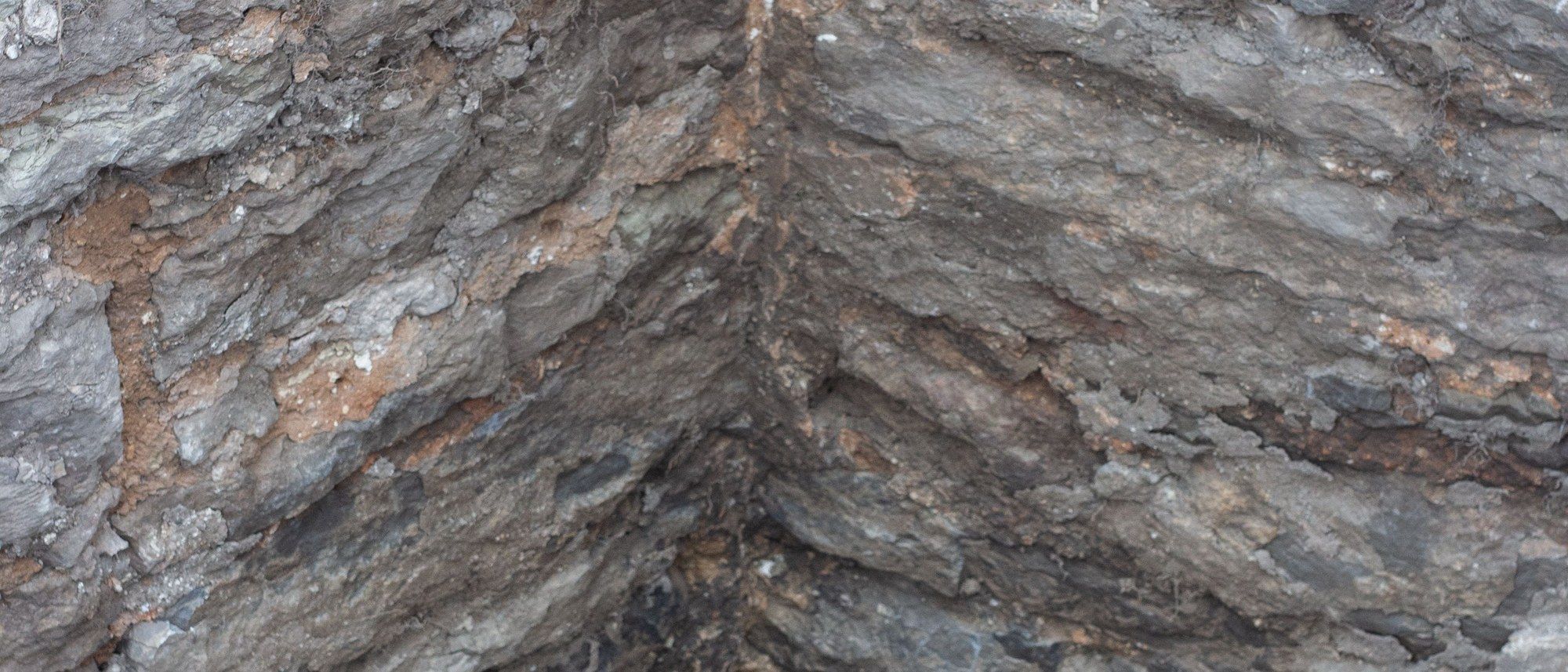
Each profile is described by the Canadian System of Soil Classification. That means the full description a designer can rely on: horizons; colour and any redox mottling that betrays a fluctuating water table; texture, with laboratory particle-size testing on the most-limiting layer; structure grade; moist consistence and compaction; the saturated or seasonal-high water table; and any bedrock, impermeable, or otherwise restricting condition.
The profile goes deep enough to prove the separation, not just to reach it. The standard requires digging or pushing to roughly 300 mm, about a foot, below the required vertical separation depth, or down to the restricting condition, whichever comes first. That extra foot is deliberate: it confirms there is no nasty surprise sitting just under the layer that would otherwise look adequate. Where a hand pit cannot reach that depth, sampling tubes can be pushed the full depth needed so the profile is complete to the controlling layer.
How the design is done in Alberta: soil, not a perc test
This is where Alberta differs from what many landowners expect. The province does not allow a percolation test as the basis of a private sewage design. The design is built from the soil itself: its texture and structure are mapped to a prescribed maximum loading rate, and the most-limiting layer in the profile controls. That is why the careful soil description above is the real deliverable, not a stopwatch reading of water dropping in a hole.
The loading rate is read from the standard's prescribed table. Coarser and finer soils each have their own value, and coarse fragments or poor structure cut the rate sharply. Prismatic or columnar structure, or a very firm to hard consistence, is treated as an automatic restrictive condition regardless of texture. The values below are taken directly from that prescribed table; your most-limiting layer sets the number your designer actually uses.
A percolation test is not useless, it is just not the design basis. Under the Alberta standard a perc test may only be used in support of a soil-profile design, as an optional verification, never as the design itself. If you or your designer want that supporting check, it can be carried out, and a short method note describing a suggested, repeatable procedure is available on request. Read it for what it is: verification, not a design basis. And be wary of hand-texturing soil by feel, the ribbon method; it is a useful field aid drawn from agricultural soils manuals, but it is not the regulatory method, which relies on laboratory particle size and the Canadian System of Soil Classification.
| Soil texture / condition | Maximum loading rate |
|---|---|
| Coarse to medium sand | 14.7 L/m² per day |
| Fine sand; coarse to medium sandy loam | 29.4 L/m² per day |
| Fine sandy loam through to clay, with suitable structure | 40.7 L/m² per day |
| Coarse-fragment content 35 to 60% | reduced to 9.8 L/m² per day |
| Coarse-fragment content 60 to 75% | reduced to 7.4 L/m² per day |
| Coarse fragments over 75%, prismatic/columnar structure, or very firm to hard consistence | treated as a restricting condition (not usable) |
A short history, water-based systems, and where the trade is trained
Private sewage practice in Alberta has moved a long way from the era of a rule-of-thumb perc test and a best-guess field size. Successive editions of the standard shifted the design onto measured soil properties and defined vertical separations, precisely because the old perc-only approach could pass a lot that later failed. That is the reason the current standard treats a perc test as support only: it was never a reliable predictor of long-term treatment on its own. The 2021 edition is the version in force today.
The systems themselves have broadened too. Alongside conventional septic fields, mounds, and at-grade systems, the standard covers water-based and higher-treatment options: packaged secondary treatment units, and disinfection add-ons that raise the effluent level and, in turn, relax the separation a tight or shallow lot can otherwise never meet. Choosing among them is a design decision that flows directly from what the evaluation finds in the ground.
The trade is a certified one. Installers hold a Certificate of Competency under the Safety Codes Act, and industry training and courses keep practitioners current on the standard and on system types. If your project runs beyond the scope of a soil and site evaluation, or beyond what a straightforward system can carry, the public Private Sewage Certified Contractors List is the place to find a certified person, and the resources below link straight to it.
What is needed, how to book, and what you get back
Booking is quick once the basics are in hand. Call us at 403 700 8672, then tell us the legal land description and civic address, what you intend to build and the expected daily wastewater flow (roughly, the number of bedrooms), whether this is a new system or a replacement, and the rough location you have in mind for the disposal area. A site plan or subdivision sketch helps, as does the location of any existing or planned water well, since separation from a well is part of the assessment. Access is arranged, ground disturbance is cleared through Utility Safety Partners before any digging, and the field visit is scheduled.
On site the test pit and profiles are opened, the soil is described and sampled, the depth to any water table or restricting layer is measured, and the conditions the design depends on are recorded. Back at the desk the most-limiting layer is identified, the loading rate assigned, the vertical separation checked against the treatment level you are aiming for, and the whole thing written up, logged, analysed, and sealed by a P.Eng.
A sample evaluation report can be provided on request so you can see exactly what you will receive before you commit. And if the ground shows that your project needs a complex-system hydrogeological investigation, or a certified installer for the build, you will be told plainly and pointed to the right next step rather than have a soil and site evaluation stretched past what it is meant to do.
When you need it
The situations this answers
- You are building a home on an acreage or rural parcel with no municipal sewer connection, and the permit requires a private sewage system.
- You are subdividing rural land and each new lot needs its own soil and site evaluation before a disposal area can be approved.
- You are sizing or siting a new septic field, mound, at-grade, holding tank, or lagoon and need the soil and separation confirmed first.
- An existing system has failed, is undersized, or is being replaced or upgraded, and the replacement must be designed to current standard.
- You are buying rural land and want to know, before you commit, whether the soil and vertical separation can actually support a private system.
- A safety codes officer, permit reviewer, or lender has asked for a soil and site evaluation prepared by a qualified professional.
- You are near a well, a water body, or a high water table and need the separation distances confirmed rather than assumed.
Standards behind this work
See the full standards shelf- Alberta Private Sewage Codes and Standards (hub)
- Private Sewage Certified Contractors List
- National Building Code, 2023 Alberta Edition
- ASTM D2488 Visual-manual soil description
- ASTM D2487 Soil classification (USCS)
- Alberta OHS Code Part 32 Excavating and Tunnelling
- Utility Safety Partners (Click Before You Dig)
- APEGA Practice Standards & Guidelines
Need the ground looked at before you build?
Describe what you are building and where. You get a reply, usually within one business day, setting out what the investigation would cover.
Sealed by Andrew Richardson, P.Eng. Serving southern and central Alberta